Most people think SOP means a dusty manual no one reads until something goes wrong.
You Google it and you’ll see the classic definition: Standard Operating Procedure – a set of detailed, step-by-step instructions to help workers consistently and efficiently complete a routine task or operation. SOPs are crucial for ensuring quality, safety, and compliance, and they guide everything from training new employees to carrying out complex processes.
A standard operating procedure records how a recurring task should be performed. It can and should be reviewed as the practice changes.
At Dental361, we use “system optimisation procedure” to describe the review process around an SOP: who checks it, what evidence they use and when it needs updating. This adds a review discipline; it does not replace the standard meaning of SOP.
Technology changes. Your PMS updates. Some tools can reduce selected administrative tasks, but their accuracy, suitability and effect on workload need to be assessed in your practice. Patient expectations evolve. Your team changes. Regulations shift.
If your SOPs don’t move with that reality, they stop being a safety net and become a liability.
That’s why I like to think of SOPs in two layers:
- Operating SOPs – the documented “this is how we do it here.”
- Optimisation SOP – the meta-process that says who reviews them, how often, and based on what information we update them.
Without the second layer, the first layer slowly rots.
The reality in many dental practices
When I start with a new practice, one of the first things we do is a data-gathering and resources check: “What SOPs do you have?”
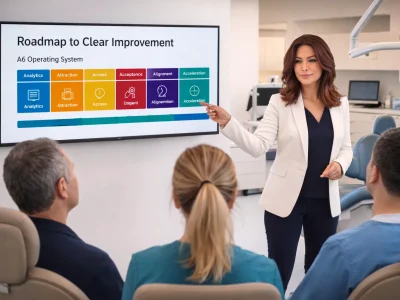
This is often one of the first areas reviewed by a Dental Practice Consultant.
The answers are usually confident:
- “Yes, we have SOPs.”
- “We did all that years ago.”
- “They’re in a folder somewhere.”
Then we go hunting.
What we find (if we find anything at all) is often:
- A 10-page document last touched 8–10 years ago.
- Written by someone who left the practice long ago.
- Describing a treatment-planning or invoicing process that no longer matches your software, your fees, or your current team.
- Printed and buried in a drawer that nobody opens unless they’re looking for AA batteries.
In the meantime, the practice has changed dramatically:
- New clinicians with different treatment planning styles.
- Updated fee schedules and item codes.
- Online bookings and SMS reminders.
- New financial policies, deposits, payment plans.
- Multiple “versions” of how things are done, depending on who’s on the front desk that day.
So yes, technically the practice “has SOPs”. Practically, they are invisible and irrelevant.
That’s not just inefficient – it’s expensive.
Why SOPs actually matter (beyond ticking a box)
Let’s strip away the buzzwords. Well-designed, current SOPs are not paperwork; they are profit systems.
Here’s what they do for you:
- Reduce chaos and firefighting
When everyone follows the same steps for bookings, cancellations, recalls, case presentations, and billing, your days are calmer. Fewer surprises. Fewer “who was supposed to do that?” moments. - Protect quality and clinical reputation
Consistent sterilisation processes, consent processes, documentation and follow-up are not optional extras. They protect patients, clinicians, and the brand you’ve spent years building. - Speed up training and onboarding
Without SOPs, every new hire becomes an informal apprenticeship: “Just follow Sarah; she’ll show you.” If Sarah leaves, the knowledge leaves with her. SOPs turn knowledge into assets that stay in the business. - Make performance measurable
You can’t measure what you haven’t defined. If your recall process isn’t written down, how will you know if it’s actually being followed, or where the drop-off is? - Enable scaling and time off
A practice that lives in your head cannot grow beyond you – and you can’t step away from something that only works when you’re there. SOPs make your practice less emotionally dependent on you. Building systems that can operate consistently without constant owner involvement is a core part of systems and operations consulting. - Lower risk and support compliance
In audits, complaints, or legal situations, “this is our documented process; here is the training record” is much stronger than “I think we usually do it this way”.
SOPs are not a nice-to-have. They are the bridge between how you want the practice to run and how it actually runs at 3:30 pm on a crazy Tuesday when two staff are off sick.
Who should write the SOPs?
Short answer: not just anyone.
You might assume the “best” person to write SOPs is:
- The owner.
- The person who’s done the job the longest.
- Someone who has done a course in management or systems.
There’s some truth in all of that – but there are risks as well.
- The owner often knows how they want it, but not always the most efficient way it happens on the ground.
- The longest-serving team member may have strong habits – some great, some outdated – and can unintentionally hard-code their preferences instead of best practice.
- The “qualified” person may design something beautiful on paper that doesn’t survive contact with a busy day.
A better way to think about authorship is:
- The owner defines the outcome, standards, and boundaries (we must stay compliant, profitable, aligned with our brand).
- The person currently doing the task well provides the real-world steps, language, and tips.
- If available, a specialist or advisor challenges assumptions, brings cross-practice experience, and ensures the SOPs link back to numbers and risk.
And then – crucially – we test it. An SOP is a hypothesis until it survives reality.
How to build SOPs that work (and don’t end up in a drawer)
Let’s break it into a simple, repeatable process. This itself can become an SOP.
Step 1: Choose high-impact areas first
Don’t start by documenting how to change a lightbulb.
Start with the processes that touch revenue, risk, and reputation:
- New patient enquiry to booked appointment.
- Treatment presentation, quotes, and finance options.
- Recalls and reactivation.
- Cancellations and FTAs.
- Invoicing, receipting, and refunds.
- Sterilisation and infection control.
- Handling complaints.
Pick one. Finish it. Then pick the next.
Step 2: Map what actually happens now
Sit with the person who currently does the task and watch. No judgement, no fixing yet.
Write down:
- What triggers the process? (e.g., patient calls, online request comes in)
- What tools are used? (software, forms, templates)
- What decisions are made along the way? (who qualifies for payment plan, how deposits are handled)
- Where things commonly go wrong.
This is your current state.
Step 3: Define the optimised “standard”
Now ask:
- Is this the best way for patients?
- Is this the best way for the team?
- Is this the best way for the business numbers?
Here’s where you might change sequence, remove unnecessary steps, add a script, or clarify who decides what. Bring in your advisor, accountant, or senior team where helpful.
The goal: a path that is clear, efficient, and profitable, not just “the way we’ve always done it.”
Step 4: Write the SOP in human language
An SOP doesn’t need to be a novel. It needs to be:
- Short.
- Clear.
- Easy to follow at 4:45 pm.
Good formats include:
- Checklists.
- Flow charts with “if this, then that”.
- Simple step-by-step instructions with screenshots.
Make sure each SOP answers:
- Who owns this process?
- When is it used?
- Where is it stored?
- What tools/templates/scripts should be used?
If people need to “decode” your SOP, it will die on the shelf.
A Dental Practice SOP Template
Process: Unscheduled treatment follow-up handover.
Purpose: Make the next agreed action visible to the team.
Trigger: A consultation ends without a treatment appointment.
Owner: The designated treatment coordinator or front-office team member.
Inputs: The clinician’s plan, current estimate, plan status and the patient’s contact preference.
Steps: Record the agreed next step, allocate the follow-up owner, schedule any consented contact and update the outcome after contact.
Exceptions: Send clinical questions back to the clinician. Respect a decision to defer, decline or stop further contact.
Handoff: The responsible clinician and follow-up owner can see the current status in the approved practice system.
Measure: Follow-ups completed within the agreed timeframe, with patient decisions recorded separately from bookings.
Version and review: Record the version, approver and review date. Review sooner if the software, process or relevant requirements change.
This is an operational example. Clinical procedures, infection control and tray setup standards need review by the appropriately qualified person responsible for those processes.
Step 5: Test it in real life
Pick a week and run the new SOP.
- Brief the team.
- Use it consciously.
- Note where it feels clunky, confusing, or unrealistic.
Update it based on feedback, not mood.
This is where the idea of System Optimisation Procedure shows up: you’re not just writing a rule; you’re actively observing and improving the rule.
Step 6: Train and embed
Once you’re happy with a version:
- Train everyone who touches that process.
- Add it to your onboarding checklist for new staff.
- Make sure the SOP is easy to find: shared drive, intranet, or practice management platform – not an orphaned PDF printed years ago.
Training is not “I sent you the link once.” It’s demonstration, practice, questions, and follow-up.
The missing piece: a SOP for optimising SOPs
Here’s where most practices fail.
They write (or pay someone to write) a set of SOPs once and treat them like stone tablets. Then:
- The software changes.
- The bank changes its payment rules.
- New guidelines show up.
- Your pricing structure shifts.
Nobody updates the documents. The gap widens between paper and reality.
This is why you need a System Optimisation Procedure – a meta-SOP that defines how you will keep your systems alive.
It can be as simple as:
- Assign an owner for each SOP
- Set a review schedule
- High-impact SOPs: review every 6–12 months.
- Lower-risk SOPs: review annually.
- Define triggers for immediate review
An SOP must be reviewed whenever:- New software or major update goes live.
- Regulations or guidelines change.
- A serious complaint, incident, or repeated error occurs.
- A key team member leaves and new staff take over that process.
- Use data, not just opinion
When reviewing, look at the numbers: The goal is not just “tidy documents” but better outcomes.- Are cancels or FTAs rising?
- Is case acceptance lower than expected?
- Are invoices often adjusted or written off?
- Are recalls slipping?
- Version control and visibility
- Clearly label versions and dates: “Treatment Presentation SOP – v3.1 – Updated June 2025”.
- Archive old versions so no one accidentally uses them.
- Keep a single, obvious “source of truth” location – not three half-updated copies across personal laptops.
- Train after every significant change
Updating the PDF is not enough. Every change needs a short huddle, explanation of why, and space for questions.
This “SOP of Optimising SOPs” is what prevents your systems from becoming 10-year-old relics buried in a drawer.
Bringing it all together
So, what is SOP really?
A standard operating procedure is a documented way of working that needs an owner and a review process.
In a modern dental practice, it’s closer to a System Optimisation Procedure:
- A living, evolving set of agreements about how you operate.
- Anchored in reality, updated on purpose, and linked to your numbers.
- Owned by specific people, not floating vaguely in “management land”.
- Visible, trainable, and testable.
If you already “have SOPs”, the next move is simple and slightly uncomfortable: check whether anyone actually uses them – and whether they match the practice you run today, not the one you had a decade ago.
From there, you can:
- Start with your highest-impact processes.
- Build clear, human-friendly SOPs.
- Put in place the meta-SOP: a System Optimisation Procedure that keeps everything fresh.
That’s where the payoff shows up: smoother days, fewer mistakes, faster training, better patient experience, and ultimately, a practice that makes money intentionally, not accidentally – whether you’re in the building or on a plane.
If recurring work still depends on the owner or informal instructions, explore our systems and operations consulting or request a free consultation.